Portuguese Water Dog Grooming: A Complete Owner's Guide in Lisbon
Everything Portuguese Water Dog owners in Lisbon need to know: the two coat types, lion vs retriever cut, grooming frequency, ear care, and honest advice from 12+ years at the grooming table.

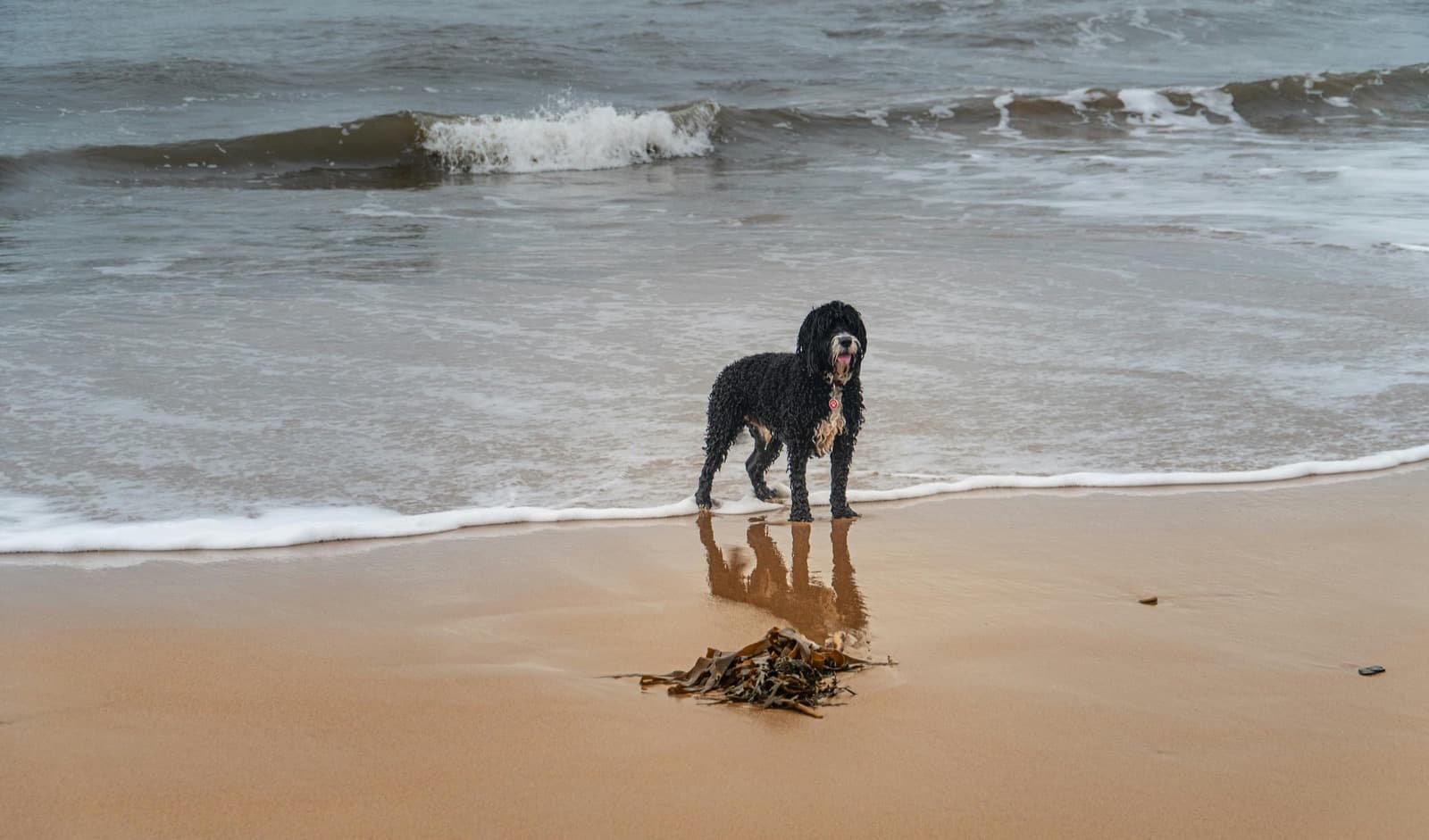
To groom a Portuguese Water Dog, brush the single curly or wavy coat weekly at home and book a professional session every 4-6 weeks, choosing either the traditional lion cut or the modern retriever cut. The breed has no undercoat, so matting is the main risk. Drop ears and water exposure also demand careful ear drying after every swim.
A Brief History: From Fishing Boats to Near Extinction
You cannot really understand Portuguese Water Dog grooming without understanding the job this dog was bred to do. These dogs worked the Portuguese Atlantic coast, particularly around the Algarve, as full crew members on fishing boats. Their tasks were genuinely impressive: herding fish into nets, retrieving lost gear from the water, carrying messages between boats, and diving to repair broken nets.
By the early 20th century, industrial fishing had made these dogs largely obsolete. Engines replaced oars. Radios replaced dogs running messages between vessels. By the 1930s, the breed was close to disappearing entirely.
What saved it was one man's decision. Vasco Bensaude, a Portuguese shipping magnate, started searching the Algarve for the remaining working dogs and built a breeding programme. A dog called Leao (Portuguese for lion), acquired from a fisherman's family in Albufeira, became the foundation sire of the modern breed. Roughly half of today's Portuguese Water Dogs trace back to him.
The breed is officially recognised by the Clube Portugues de Canicultura, the Portuguese kennel club, and is registered with the FCI as breed standard number 37. It is one of Portugal's native breeds, though calling it the country's official "national dog" overstates things. It is simply one of several Portuguese breeds, alongside the Rafeiro do Alentejo, Serra da Estrela, and others. What matters for owners in Lisbon is this: you have a dog whose entire grooming style was designed around water work, and that history still shapes the right choices today.
Understanding the Coat: Curly vs Wavy
The FCI breed standard recognises exactly two coat varieties, and every Portie you'll meet falls into one category or the other. In Portuguese, the breed standard calls them cacheado (curly) and ondulado (wavy).
Curly (cacheado): shorter, dense, dull (not shiny), forming compact cylindrical curls. On the head, the topknot is made of tight curls.
Wavy (ondulado): longer, slightly shiny, with a softer, slightly woollier feel. The hair falls in gentle waves rather than tight curls, and the topknot is wavy rather than curled.
Why this matters at the grooming table
The coat varieties behave differently under the dryer and under the clipper. A curly coat tends to bounce back into compact curls the moment it dries, holding shape well. A wavy coat dries into a softer, more relaxed finish and can look fluffier between sessions. Clipper length that reads as neat on a curly coat can look overly shaggy on a wavy coat, and vice versa.
The single coat factor
This is the most important technical fact about the breed and the detail most owners miss: the Portuguese Water Dog has a single coat. No undercoat. The standard specifies the whole body is covered with strong hair, and nothing grows underneath.
Practicalities that follow from this:
- They shed far less than a double-coated breed like a Labrador, which is why they're often labelled "hypoallergenic". The honest version: no dog is truly hypoallergenic. The American Academy of Allergy, Asthma and Immunology is clear on this. But low-shedding single-coated breeds do release less allergen around the home, so allergy sufferers often do better with a Portie than with many breeds. Just don't expect zero reaction.
- The hair keeps growing instead of cycling out the way a double coat does. This is why Portuguese Water Dogs mat readily and need consistent professional grooming.
- Without an insulating undercoat, shaving too short changes the dog's relationship with temperature and UV more than it would for most breeds.
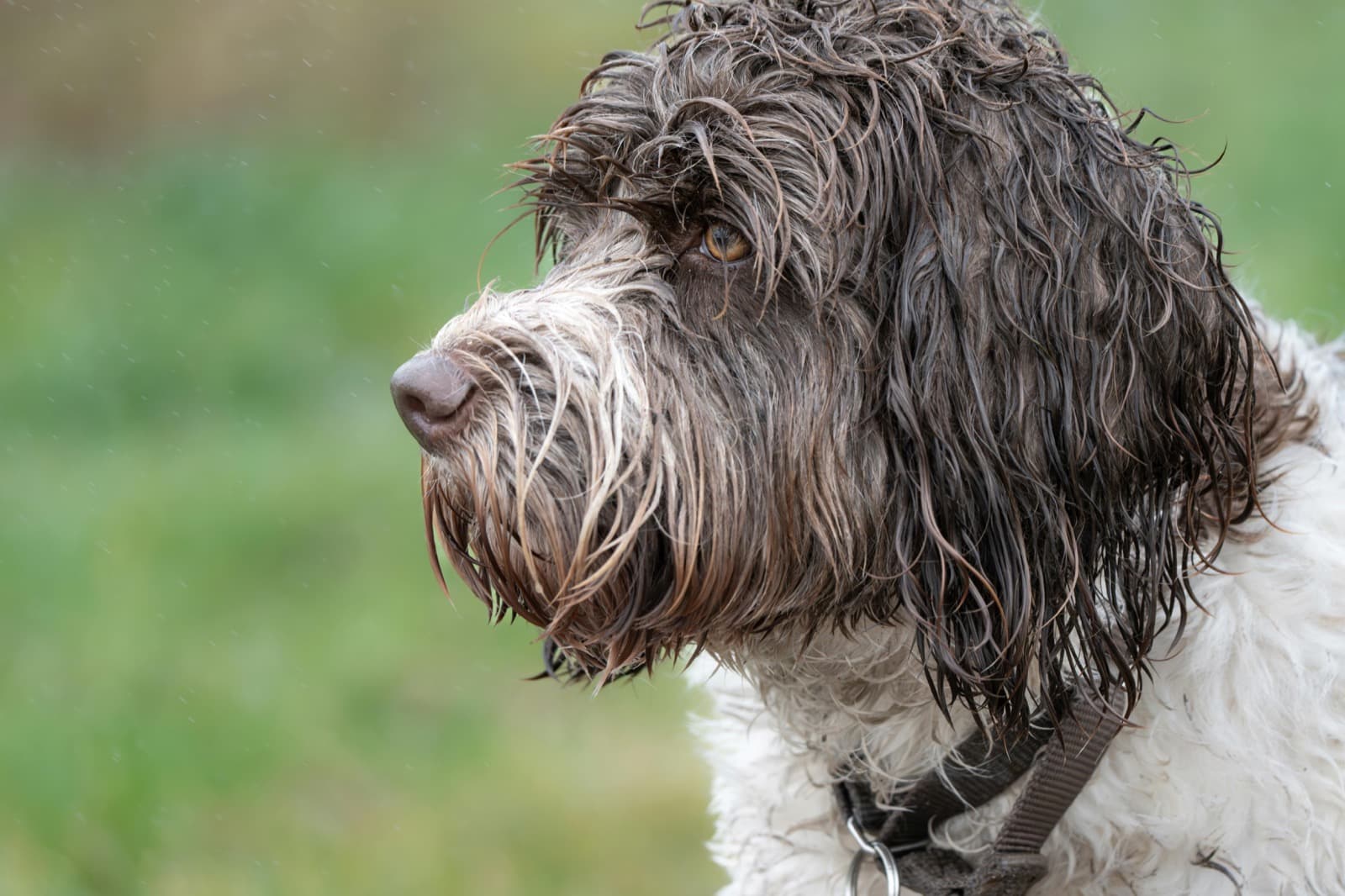
The Two Traditional Cuts: Lion vs Retriever
There are two recognised cuts for this breed, and both are accepted in the show ring. But they mean very different things practically.
The Lion Cut
This is the historical working cut. The hindquarters are shaved, the muzzle is shaved, and the tail is shaved except for the last third, which is left long as a "flag" or plume. The front half of the body keeps its full coat.
There is a functional explanation for every part of this cut, and it isn't decorative. The full front coat protected the dog's heart, lungs, and vital organs from cold Atlantic water. The shaved hindquarters gave the powerful back legs and rudder-like tail freedom to swim efficiently. The tail flag stayed visible above the waterline so fishermen could spot the dog from the boat. The shaved muzzle stayed cleaner when the dog was fed on raw fish scraps.
Everything that looks dramatic about the lion cut today was, originally, practical.
The Retriever Cut
The retriever cut is the more modern option. The coat is kept at an even length across the entire body, usually somewhere between 2.5 and 4 cm. It's softer-looking, lower-profile, and easier for most pet owners to maintain between sessions.
The retriever cut developed partly because the lion cut looks unusual to people unfamiliar with the breed, and partly because even coat is simpler for groomers and more forgiving between appointments.
Quick comparison
| Factor | Lion Cut | Retriever Cut |
|---|---|---|
| Historical origin | Traditional working cut | Modern adaptation |
| Visual impact | Dramatic, breed-typical | Soft, uniform, Labradoodle-like |
| Maintenance between grooms | Legs and front coat mat faster | More even, generally easier |
| Swimming comfort | Designed for it | Fine but heavier when wet |
| Works for | Show dogs, breed enthusiasts, confident owners | First-time PWD owners, pet homes |
| Warm weather suitability | Better in summer (shaved hindquarters) | Hot once wet, traps heat if too long |
There are also variations that sit between the two: modified lion cuts where the hindquarters are scissored short rather than fully shaved, and working retriever cuts with slightly more length on the topline. A good groomer will adjust the style to how you actually live with the dog, not just copy a photo.
Grooming Frequency and What to Expect
The Portuguese Water Dog Club of America recommends a full groom every 6 weeks, with many owners and handlers booking every 4-6 weeks depending on the individual dog. That is a faster cycle than the average pet dog, and it reflects the reality of a fast-growing single coat that mats easily.
Here's a practical schedule you can actually use:
- Every 4-6 weeks: full professional full body grooming session - bath, blow-dry, clipper work, scissor finish, nail trim, ear cleaning
- Weekly at home: proper line brushing (more on this below)
- After every swim: rinse with clean water, dry ears, light towel dry
What a full PWD groom actually involves
A complete Portuguese Water Dog session at our salon in Campolide typically runs 2 to 3 hours from start to finish. The time is not padding - this coat needs each step done properly:
- Pre-brush and mat check (10-15 min): We work through every section before water touches the coat. Wet mats become concrete.
- Bath (20-30 min): Two washes with a gentle shampoo for single coats, plus conditioner. Double-washing matters because a working-coat type absorbs product deeply.
- High-velocity dry (30-45 min): A force dryer blasts water out of the coat and separates the hair. This step is where a lot of salons cut corners, and it shows.
- Clipper work and scissoring (45-60 min): Depending on whether you're doing a lion cut, retriever cut, or hybrid. The head, topknot, and tail flag are all hand-shaped.
- Ears, nails, paw pads, sanitary (10-15 min): Finishing work.
If someone offers you a "quick" Portuguese Water Dog groom in under 90 minutes, something is being skipped. Usually the high-velocity dry, which is where coat damage and matting start.
For more on how often different coat types need professional care, see our full piece on how often you should groom your dog.
Home Care Between Appointments
This is the area where owners either make my job easy or add two hours to the next session. There is no middle ground with a single-coated, mat-prone breed.
Tools you actually need
- Slicker brush with medium-soft pins: your main weekly tool
- Metal comb, medium and fine-toothed combination: the honesty test after brushing
- Detangling spray for curly coats: reduces pulling and breakage
- Dematting rake or splitter: for emergencies only, not routine work
Skip the rubber grooming mitts and bristle brushes. They look nice in adverts but do nothing for a Portie coat.
The line-brushing technique
Superficial brushing over the top of the coat is almost useless on this breed. You can brush for 10 minutes, see nothing on the slicker, and still have a coat full of mats underneath. Here's the approach that actually works:
- Part the coat down to the skin with one hand.
- Brush the exposed section outward in short strokes.
- Move the parting up by about a centimetre.
- Repeat until you've worked through the entire section.
- Follow up with the metal comb. If the comb passes through with no resistance, the section is done. If it catches, brush again.
Aim for 10-15 minutes twice a week. That is the PWDCA's general recommendation, and in my experience with this breed in Lisbon, it's accurate.
Where mats actually form
Not every part of the coat mats at the same rate. The zones I open up most often at appointments, in order of frequency:
- Behind the ears and around the ear base - constant friction from collars and head shaking
- Under the front legs (armpits) - skin-on-hair rubbing as the dog walks
- Around the collar line - especially if the collar is wet and stays on
- Between the hind legs and belly - gets damp from beach and park visits and stays damp
- The tail base - where the dog sits
If you focus your weekly brushing on these five areas, you'll prevent 90% of the dematting work in between grooms.
For comparison with technique differences in other coat types, see our article on hand stripping vs clipping. Hand stripping doesn't apply to PWDs because they're not a wire-coated breed, but understanding why helps clarify what your Portie actually needs instead.
Ear Care: The Part Most Owners Underestimate
Portuguese Water Dogs have drop ears that lie close to the skull, and they love water. Those two facts together create the single most common health issue I see in this breed: moisture-related ear irritation and infection.
The mechanism is simple. Water gets into the ear canal when the dog swims. The ear flap traps warmth. The canal stays damp. Yeast and bacteria grow in that environment. A week later, the dog is shaking their head and scratching.
A realistic ear-care routine for a PWD in Lisbon
Because many Porties in Lisbon swim year-round at Carcavelos, Guincho, or the Tejo, the care routine needs to be consistent:
After every swim:
- Gently dry the inside of the ear flap with a soft cotton pad or clean gauze
- Do not push cotton into the ear canal - you only clean what you can see
- If your dog has been in salt water, give the ears a gentle wipe with clean water first, then dry
Weekly, as routine:
- Lift each ear flap and check inside for redness, dark brown or black wax buildup, or unusual odour
- Healthy Portie ears are pale pink inside with minimal wax and only a faint, neutral smell
- Use a vet-approved ear cleaner designed for dogs once a week if your dog swims frequently
Signs to book a vet appointment, not wait:
- Sour or yeasty smell
- Head shaking or ear scratching beyond normal
- Visible redness, swelling, or discharge
- Your dog pulls away when you touch the ear
The plucking question comes up a lot. Some breeds benefit from ear hair plucking to improve airflow in the canal. For Portuguese Water Dogs specifically, the current veterinary guidance is more cautious - pluck only what is clearly dead and loose, not all of it, because aggressive plucking can cause micro-trauma that makes infections more likely. We discuss this individually at appointments depending on the specific dog's ear shape and history.
Common Grooming Mistakes Owners Make
After enough years at the grooming table, you start seeing the same avoidable errors on repeat. Here are the four I see most often with Portuguese Water Dog owners in Lisbon.
1. Shaving too short in summer
This is the big one. Lisbon summers get hot, and the instinct is to shave the dog right down to cool them off. It doesn't work the way people think it does, and for a single-coated breed, it has real consequences.
The coat is actually part of the dog's temperature regulation and UV protection. Shaved too short, the skin is exposed to direct sun, and the coat texture itself can come back different - softer, sparser, sometimes patchy. Rather than a full shave, a properly trimmed retriever cut at 1-2 cm keeps the dog cool enough while preserving coat integrity.
2. Infrequent brushing with aggressive dematting later
Some owners brush for five minutes every couple of weeks, think everything is fine, and then bring the dog in with mats they didn't realise were there. Dematting a severely matted coat is slow, sometimes painful for the dog, and occasionally ends with a mandatory short shave because the coat is too compromised to save.
Either you brush properly and weekly, or you shorten the gap between professional sessions. Both are fine. What doesn't work is brushing casually and visiting the groomer every 10 weeks.
3. Bathing at home without proper drying
A Portie dried under a bath towel and left to air-dry is setting up for mats within 24 hours. A single coat needs force-drying to separate the curls or waves; air-drying lets them clump together. If you bathe at home between grooms, you need at least a decent-quality pet dryer. If you don't have one, it's genuinely better to rinse off dirt with water only and wait until the next groom for a full wash.
4. Using the wrong tools
De-shedding rakes (the kind marketed for Labradors and Huskies) can damage a single coat. Scissors wielded by owners trying to fix a bad haircut rarely end well - see any groomer's story about emergency-fix appointments. Stick with slicker, comb, detangle spray, and leave the clippers and scissors for the professional.
Lisbon-Specific Considerations
Living with a Portuguese Water Dog in the city this breed actually comes from has a few practical quirks.
Atlantic humidity keeps the coat slightly heavier and slower to dry than it would be in a drier climate, which means more drying time at home and a bit more attention to those damp mat zones I mentioned earlier.
Beach access is both a gift and a maintenance tax. Salt water is harder on the coat than fresh water, and sand works its way into the leg feathering and paw pads. A quick fresh-water rinse after Guincho, Carcavelos, or Costa da Caparica adds a minute and saves a surprising amount of damage.
Summer heat in July and August can be intense, and this is exactly when owners are most tempted to over-shave. Think moderate retriever cut with paw-pad trimming rather than a near-shave.
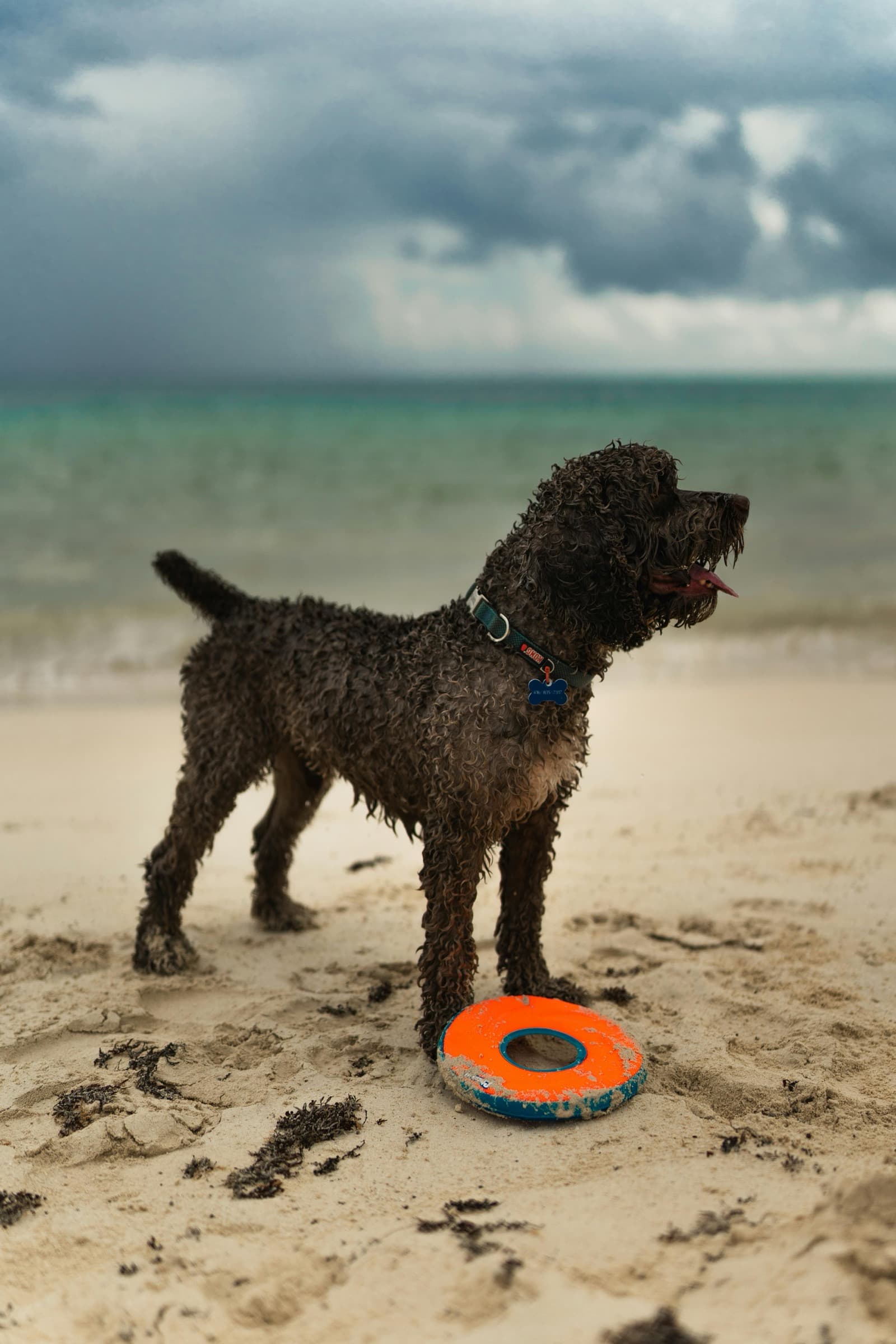
On the positive side, living in Lisbon means the dog gets to do the thing it was literally bred to do. Watching a Portuguese Water Dog swim in the Atlantic is one of those moments where the breed just makes sense.
The Short Version
If you take only a few things from this article, take these:
- Your dog has a single coat, no undercoat. Plan accordingly: weekly line-brushing, a full groom every 4-6 weeks.
- Lion cut or retriever cut - both are valid. Lion cut for breed enthusiasts and dogs who swim often in cool water; retriever cut for most pet homes.
- Never shave completely short in summer. It costs more than it gains.
- After every swim: rinse, dry the ears, check for sand in the paws.
- At the first sign of ear odour, head shaking, or redness - book the vet, don't wait.
If your Portuguese Water Dog hasn't been professionally groomed in more than 6 weeks, or if you're transitioning from one cut to another and want honest advice about what your specific coat can handle, come and say hello.