Matted Dog Hair: What Causes It, How to Prevent It, and When You Need a Professional
Matting is a welfare issue, not an aesthetic one. A groomer's honest guide to why matts form, how to prevent them, when to safely de-matt at home, and when to call a professional.

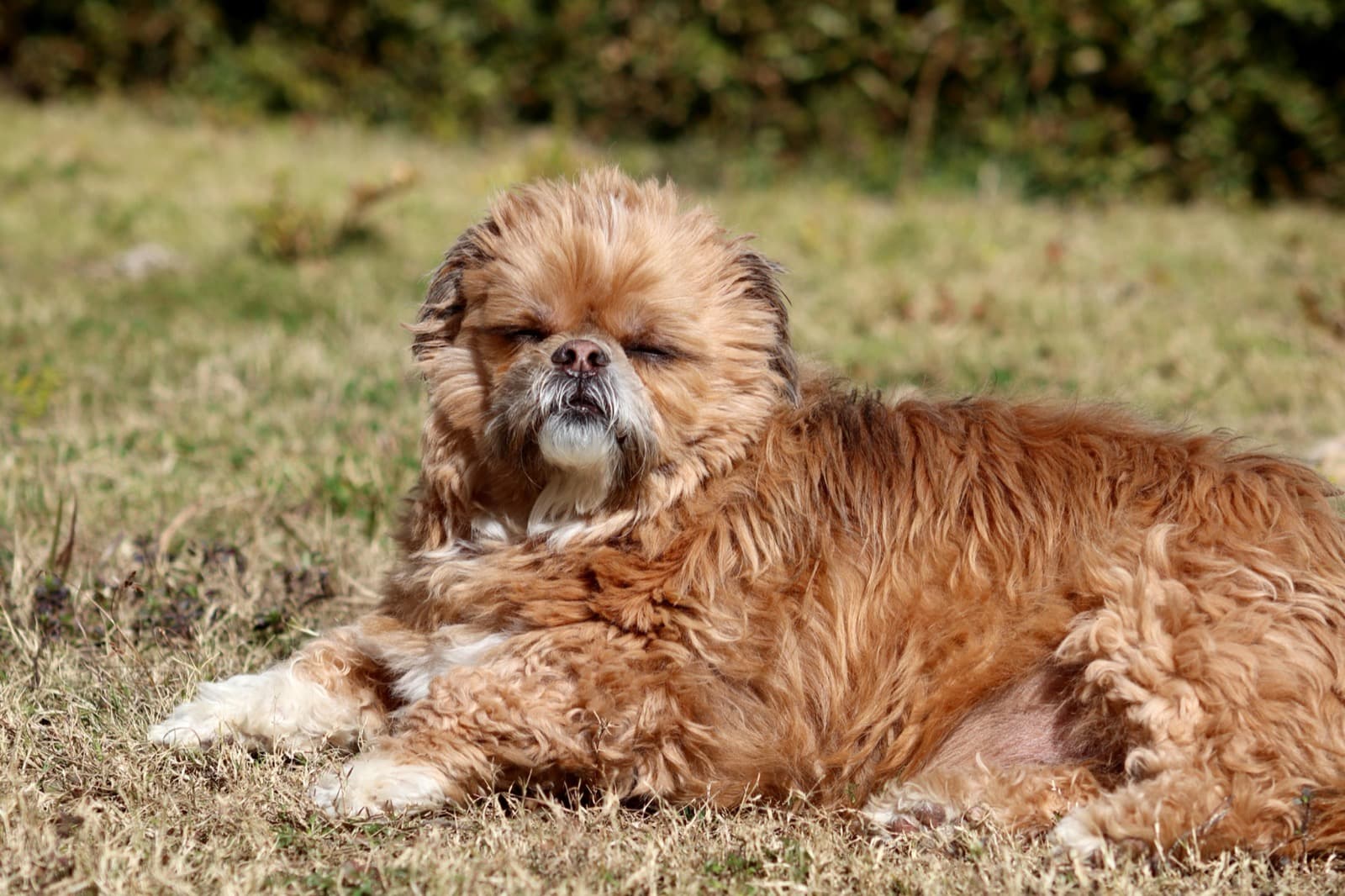
Matting happens when dead shed hair tangles with live hair and tightens against the skin, and it is a welfare issue, not a grooming one. Tight mats restrict blood flow, trap moisture, and hide wounds. The single biggest cause is skipped brushing on high-risk coats like Doodles, Poodles, and Bichons. Prevent it with daily line-combing using a slicker and metal comb, always before a bath.
Why Matts Form in the First Place
Most owners assume matting is mainly a breed problem. It is not. Breed sets the difficulty level, but habits and life events decide whether a coat actually matts. These are the seven causes I see most often at the salon:
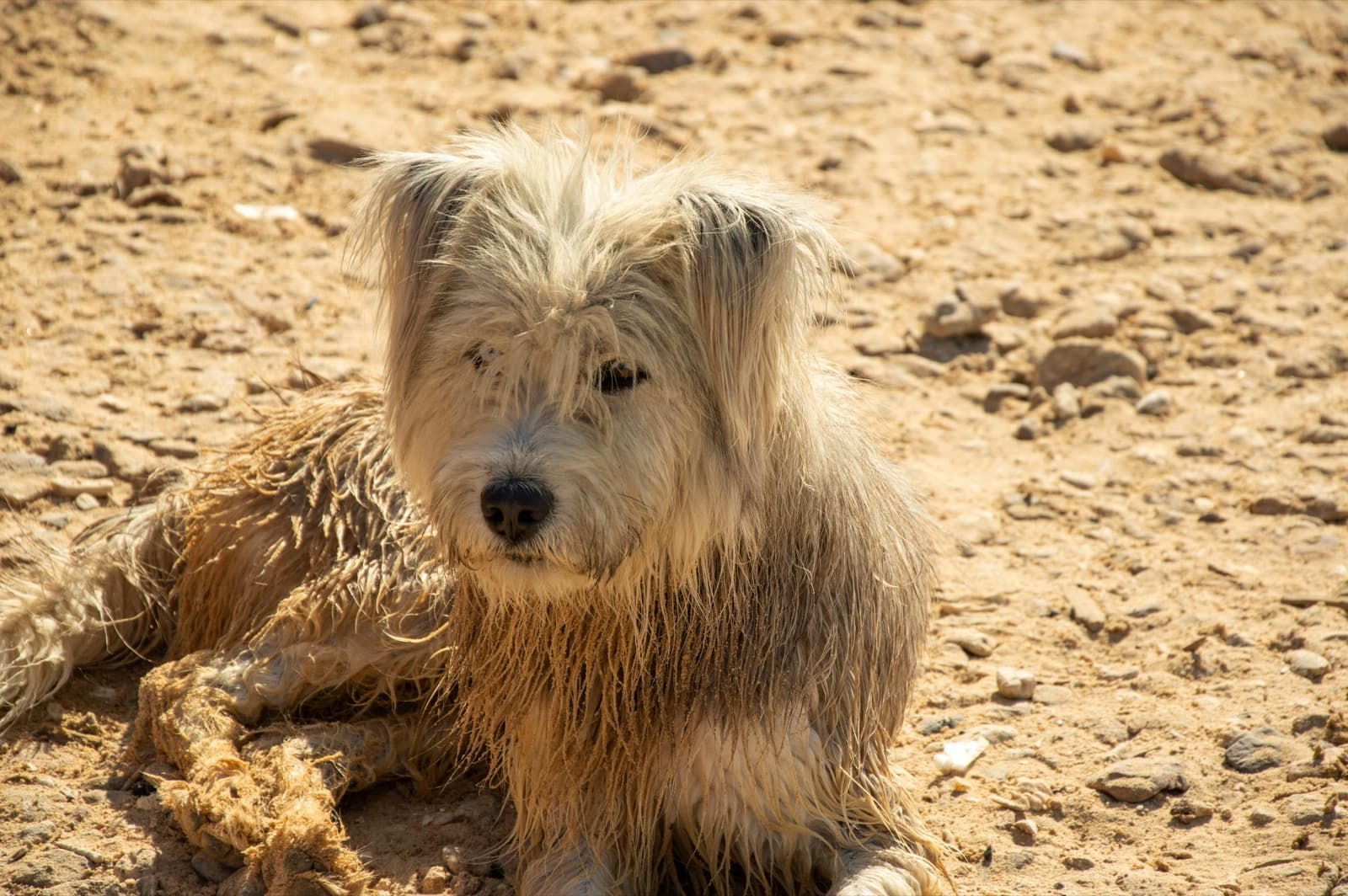
1. Insufficient brushing. This is by far the biggest single factor. A coat that sheds into itself needs a human to remove the dead hair before it tangles. Miss a week on a doodle and you can already feel the undercoat compacting at the skin.
2. The wrong tools. A slicker brush alone skims the surface and completely misses the mats forming at the skin. If all you own is a slicker, you are almost certainly leaving a hidden layer of tangles untouched. A proper kit needs a metal comb, a slicker, and for heavier coats a de-matting rake.
3. Bathing a dirty coat without brushing first. Water plus existing tangles equals cement. I cannot overstate this. Shampoo and water tighten any existing knot into a dense lump that is often impossible to separate afterwards. Brush first, bathe second, always.
4. Friction spots from collars, harnesses, and daily wear. The chest under a harness, behind the ears where collars sit, armpits, and the base of the tail rub fibers together many hundreds of times a day. These are the places matts form first and deepest.
5. Seasonal coat blow in double-coated breeds. Spring and autumn releases of undercoat in Huskies, Goldens, and German Shepherds compact at the skin if not deshedded. The mat looks different to a doodle mat, more like felt than a cord, but the effect on the skin is the same.
6. Medical causes. Allergies make a dog lick or chew one spot until the hair felts locally. Skin infections change the oil balance of the coat. Senior dogs lose the flexibility to groom themselves. Overweight dogs cannot reach their back or rear. All of these produce very predictable patterns of matting in specific places.
7. Life events. Rescue dogs arrive with a backlog of neglect that cannot be brushed out. Post-surgery dogs wear cones that prevent normal grooming behaviour. Dogs recovering from injury lie on one side for weeks and matt along that flank. None of this is owner failure. It is just life, and the solution is almost always a short reset coat and a fresh start.
Which Dogs Mat the Most
Not every coat matts the same way, and the prevention routine changes with the coat type. Here are the groups at highest risk, the ones we see repeatedly at the salon:
Doodles and cross-breeds
Cockapoos, Labradoodles, Goldendoodles, Bernedoodles, Cavapoos. These are the number one matting breeds we meet. The reason is simple: they inherit a curly or wavy coat with low natural shedding, which means all the dead hair stays in the coat instead of falling out. Without daily intervention, that trapped hair becomes a mat within days. A doodle is not a low-maintenance dog. A doodle is a dog that needs daily brushing and a professional groom every 4 to 6 weeks.
Continuous-growth coats
Poodles, Bichon Frise, Maltese, Shih Tzu, Lhasa Apso, Havanese. Their hair keeps growing like ours does, it does not cycle out. The coat has no natural stopping point, so any tangle just keeps extending and compacting. These breeds reward a consistent grooming schedule and suffer when owners stretch between appointments.
Feathered breeds
Cocker Spaniels, Springer Spaniels, setters, feathered retrievers. The short body hair is easy, but the long feathering on the ears, legs, chest, and belly matts the moment it gets wet, muddy, or sticky. Most matts we find on spaniels are on the legs and under the ears.
Double-coated breeds during coat blow
Huskies, Malamutes, Golden Retrievers, German Shepherds, Border Collies, Australian Shepherds. These dogs do not form ropy matts the way a doodle does, but during spring and autumn coat blow the undercoat releases in huge quantities and compacts into felt-like pads against the skin if it is not deshedded. Owners often assume the topcoat looks fine and miss the felting underneath.
Any dog with a medical or age factor
Senior dogs, overweight dogs, arthritic dogs, dogs with ongoing allergies or skin conditions. These dogs matt regardless of breed, because the normal grooming mechanisms, both self-grooming and the owner's routine, are disrupted. Plan grooming frequency around the dog, not around the book.
Prevention: The Routine That Actually Works
The prevention routine is boring on purpose. Boring is what stops emergencies. If you own a high-risk coat, here is what I ask clients to do between salon visits.
Daily for high-risk coats
Ten minutes of proper brushing every day. Not a quick surface pass. Ten focused minutes covering the head, ears, chest, armpits, legs, and tail area. For doodles and continuous-growth coats, finish every session with a metal comb from skin to tip. If the comb stops, you have found a mat that the slicker missed.
Twice a week for medium-risk coats
Short-haired spaniels, setters, medium double coats. Focus on the feathering and friction spots. A full body brush twice a week with daily checks on the legs and behind the ears is usually enough.
Weekly minimum for low-risk coats
Short smooth coats. Mostly a deshedding tool and a quick check over the collar area. The risk here is mainly during seasonal shed.
Line combing: the professional method
This is the single most important skill an owner can learn. Most home brushing fails because it only touches the outer coat, leaving the skin-side tangles untouched. Line combing fixes that.
Here is how to do it on a doodle or any continuous-growth coat:
- Sit or kneel next to a relaxed dog on a non-slip surface.
- Start at a leg or the rear, never the head.
- Part the coat horizontally with one hand, exposing a narrow line of skin.
- With the other hand, brush only the section just above that parting, from the skin outward.
- Run a metal comb through the same section to confirm it is clean.
- Move the parting up by about two centimetres and repeat the whole process.
- Work up the body in horizontal lines until every section has been cleared from skin to tip.
Done properly, line combing takes about 15 minutes on a medium doodle, and it catches problems before they become matts. This is exactly the method groomers use on the table.
Daily hotspots to check
Behind the ears, under the collar, chest under the harness, armpits, groin, between the toes, under the tail, and any spot the dog lies on most often. Ninety percent of matts form in these places, and ninety percent of them can be caught in thirty seconds of daily checking.
The Tools You Actually Need
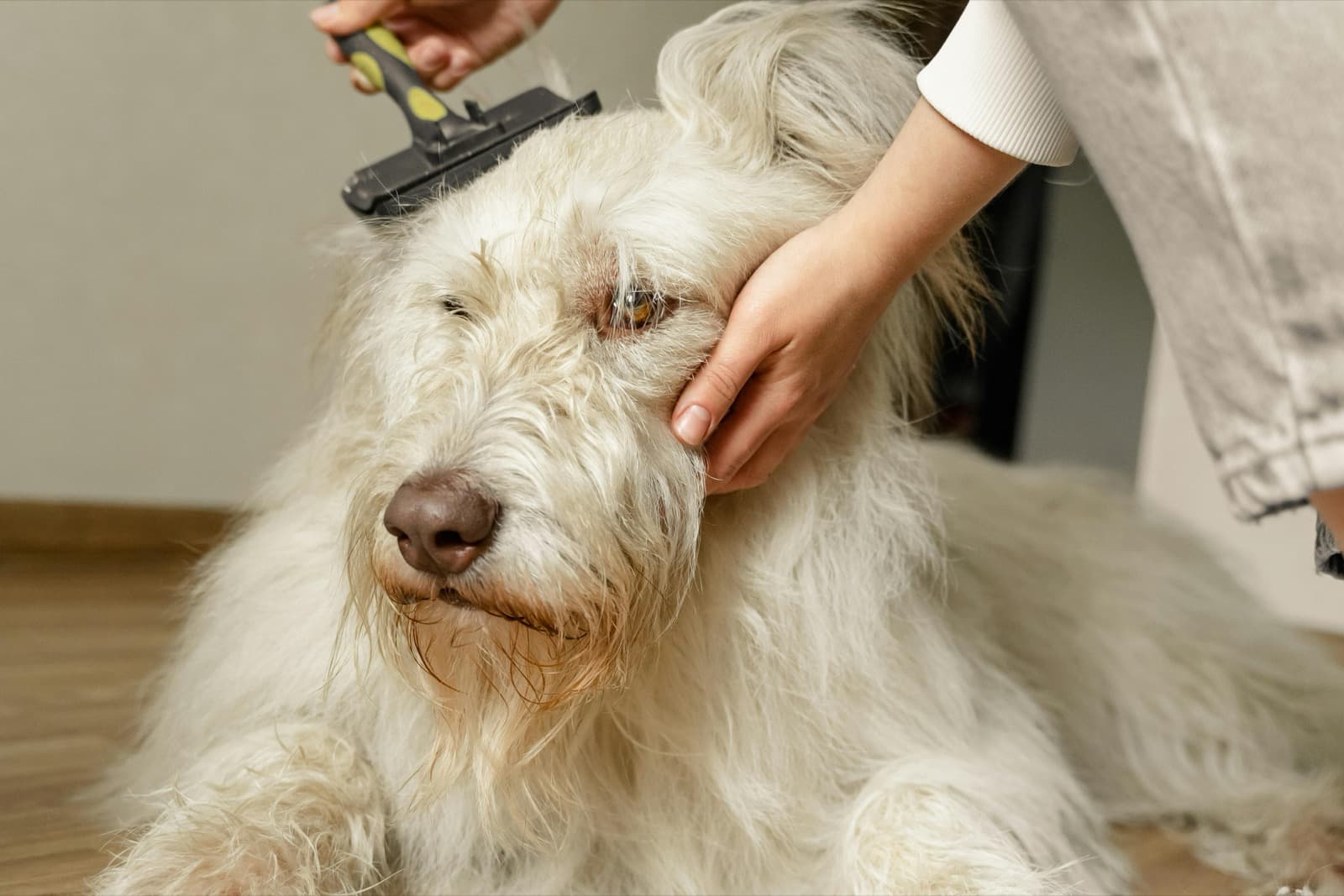
Most pet shops sell a confusing wall of brushes. You do not need most of them. Here is the short list, in order of importance.
1. Metal comb with wide and fine teeth. This is the most important tool in the kit. Brands like Chris Christensen, Andis, and Artero sell reliable options. The rule: if the comb passes through the coat from skin to tip with no resistance, the coat is mat-free. If it stops, there is a mat. Nothing else gives you the same honest feedback.
2. Slicker brush. Soft pins for the face, legs, and sensitive areas. Firmer pins for the body. Use a slicker to lift the coat and remove loose debris before the comb.
3. Pin brush. Optional, mostly for final finishing on longer coats. It lays the hair smoothly after the slicker and comb have done the real work.
4. De-matting rake. Useful for lifting and loosening compacted undercoat in double-coated breeds. Not a tool for forcing through tight matts on the skin. If you are pulling with a rake, stop.
5. Detangling spray. A silicone or conditioner-based spray softens fibers and reduces friction. Spray the area before working on any tangle. Never brush a dry, unsprayed mat. It hurts and it damages the coat.
6. A dryer with a stand. For anyone with a doodle, spaniel, or double coat, a force dryer or stand dryer is not a luxury. Air plus brushing separates fibers in a way a towel never will. After any wash, always blow-dry while brushing, never let a high-risk coat air-dry.
Tools that are overrated or harmful
The cheap plastic slickers in supermarket aisles bend and skip over real mats. Furminator-style stripping blades are fine on double coats but should never be used on doodles or single coats, where they cut live hair and create texture damage. Mat splitters and blades are professional tools. In an owner's hands they cause cuts more often than they solve matts, and I would rather you skip them and book a professional.
Can I De-Matt at Home? An Honest Decision Tree
Owners often ask if they should try to de-matt at home before booking. Sometimes yes, sometimes absolutely not. Here is the honest answer.
Yes, this is a home job
- The tangle parts with your fingers when you pull gently on both sides.
- The mat is smaller than a coin and is not pressed tight against the skin.
- You can see the skin through the mat, and the skin looks healthy and pink, no redness, no damp patch, no smell.
- The dog is calm, tolerant of handling, and does not flinch when you touch the area.
- You have the right tools and at least twenty unhurried minutes.
If all five are true, you can probably separate the tangle gently at home using the process in the next section.
No, book a professional
- The mat is tight against the skin and feels hard or board-like to the touch.
- There is more than one mat, or the mats are spread across multiple areas.
- The skin under the mat looks red, irritated, damp, or smells of bacteria or yeast.
- The dog tenses, flinches, pulls away, or tries to snap when you touch the area.
- You cannot see or feel the skin through the coat at all.
- The dog is a rescue, post-surgery, senior, or otherwise in a delicate state.
If any one of these applies, please put the brush down. Hours of painful home brushing is worse for the dog than a twenty-minute professional reset. At the salon we have the tools, the experience, and the right light to see damage before it gets worse. And we will be honest with you about whether the coat should be brushed, partially shaved, or fully reset.
How to Safely Work on Small Tangles at Home
If you have read the decision tree above and you are confident this is a home job, follow this sequence. The goal is to remove the tangle without causing a single moment of pain.
Step 1. Set the scene. Pick a quiet room, good light, and a non-slip surface. Have treats ready. If the dog is anxious, do nothing that day beyond a few short positive sessions to build trust.
Step 2. Spray generously. Cover the area with detangling spray, work it in with your fingers, and wait a minute for the fibers to relax. Never work a dry mat.
Step 3. Anchor at the base. Grip the mat between two fingers close to the skin, never at the tips. This is the single most important safety rule. Every pull you make should tighten against your fingers, not against the dog's skin. If you feel the skin move, you are holding too far out.
Step 4. Pick, do not rip. Use the teeth of a metal comb or the tip of your fingers to separate small sections from the outside edges of the mat inward. The goal is to split one mat into two smaller mats, then four smaller ones, then comb the fragments out. If at any point you feel yourself wanting to pull hard, stop. That means the tool is wrong, the mat is too deep, or it is a shaving case.
Step 5. Work the fragments. Once a section is broken into fine pieces, comb from the skin outward in short strokes. Check after each stroke that the comb is running free.
Step 6. Take breaks. Never work on one spot longer than ten to fifteen minutes. Dogs lose patience even when they are not in pain, and grooming associations are built in these sessions, for better or worse. Treats and short breaks cost you nothing and protect years of future cooperation.
Step 7. Know when to stop. Some mats will not come out without pulling skin. Shave them. Hair grows back in weeks. Skin damage and grooming trauma take years to recover from, or never fully recover at all. A groomer with clippers is almost always the kinder choice.
When to Book a Professional
Our job is not just to tidy the outside of a dog. It is to read the whole coat, find hidden problems, and choose the kindest way forward. A good groomer tells you honestly when brushing is still a realistic option, and when it is not.
When you bring a matted dog to PawsN'Surf full body grooming, here is what we actually do:
- Skin check first. We part the coat in the high-risk zones and check the skin for redness, damp patches, sores, parasites, or signs of infection before any tool touches the mat.
- Honest conversation. If brushing out is the right answer, we tell you how long it will take, how much it will cost, and whether the dog is likely to tolerate it. If a shave is the right answer, we explain why and what regrowth will look like.
- Gentle sectioning. For brushable coats, we work in small sections with the right tools, stopping if the dog shows stress.
- Thorough blow-out. Force drying separates the fibers mechanically while we brush. It is the secret of a doodle groom that stays tangle-free longer.
- Coat strategy going forward. We discuss maintenance length, schedule, and home routine. Prevention is cheaper and kinder than crisis.
For breeds with a working-type coat where hand-stripping is an option, read our related guide on hand-stripping vs clipping. It is not relevant for doodles and continuous-growth coats, but for terriers and certain spaniels it changes the whole conversation.
Humanity Over Vanity: When a Shave-Down Is the Kindest Answer
There is a phrase that has become a quiet ethic across professional grooming: humanity over vanity. Popularised by groomers like Mackensie Murphy and embraced by associations like the NDGAA and IPG, it means exactly what it sounds like. When a dog is badly matted, the welfare of the dog ranks above the aesthetic preference of the owner.
If a coat is shaved short because it was too painful to brush, that is not a bad haircut. It is not a failure of the groomer. It is not even, honestly, a failure of the owner. It is a reset. A way to stop the suffering immediately, remove the weight, let the skin breathe, and give the coat a chance to grow in fresh and healthy. Most coats recover beautifully in six to twelve months of consistent care.
The alternative, hours of painful de-matting, has costs most owners do not see:
- Brush burn on the skin, which looks like an abrasion and can take weeks to heal.
- Hematomas from the constant pulling.
- Psychological trauma that can make a dog grooming-averse for life. Some dogs never recover their tolerance after a traumatic de-matting session, and every subsequent groom becomes harder for everyone.
- Hidden wounds that get torn open during the brushing and need vet treatment.
So when we say a dog needs to be shaved, we are not giving up. We are choosing the option that actually serves the dog in front of us. Coat grows back. Psychological scars and skin damage do not, or at least not easily. A good groomer who tells you honestly that a shave is the right call is doing their job properly, and a salon that lets an owner pressure them into brushing out a severely matted dog anyway is doing the opposite.
If your dog comes home from PawsN'Surf with a shorter cut than expected, it is because we chose the option that served the dog. The hair will grow back. What we protected in those twenty minutes, you will see in the way your dog behaves at the next groom.
Hidden Damage, and When It Is a Vet Problem
Matting is sometimes the warning light for something deeper. Owners regularly miss the signs that skin underneath has already been damaged, because the coat hides everything until the mat is removed. Here is what to watch for at home.
Signs of hidden skin damage
- Your dog licks, scratches, or nibbles at one specific spot repeatedly.
- A faint smell of bacteria or yeast from an area of coat.
- Your dog flinches or moves away when you touch a particular zone.
- Dark, damp-looking patches on an otherwise dry coat.
- Warmth, redness, or visible scabs when you part the hair.
Any of these means the mat is not just cosmetic. There is a skin problem underneath, and the sooner it is exposed and treated, the better.
When to go to the vet, not just the groomer
Sometimes a matted coat hides something only a vet can treat. Book a veterinary consultation, not a grooming appointment, if you see:
- Raw, oozing, or clearly infected skin under matted areas.
- Maggots in the coat or near wounds. This does happen in severe neglect or heavy summer in outdoor dogs.
- Fleas or ticks matted into the coat, especially if the skin looks inflamed.
- Fever, lethargy, or loss of appetite alongside coat problems.
A vet should address the health issue first. Grooming happens afterwards, often as a shave-down, to give the skin space to heal.
Cost of prevention vs cost of crisis
The honest economics look like this. Ten focused minutes of daily brushing plus a professional groom every six to eight weeks keeps a high-risk coat healthy for the price of a maintenance appointment. A matted crisis means a shave-down, possible vet costs for skin treatment, a longer-than-usual regrowth phase during which your dog is more exposed to weather, and often months of rebuilding grooming tolerance. Prevention always wins.
For more on the day-to-day routine and frequency, see our companion guides on coat care between grooming appointments and how often you should groom your dog.