How to Brush Your Dog at Home: Step-by-Step Guide by Coat Type
A practical, honest guide from a Lisbon salon with 12+ years of coat experience. Which brush to use, the 45-degree slicker angle, line combing, and the mistakes that quietly create matts. Written for Portuguese Water Dogs, Doodles, Yorkies, Labs and everyone in between.

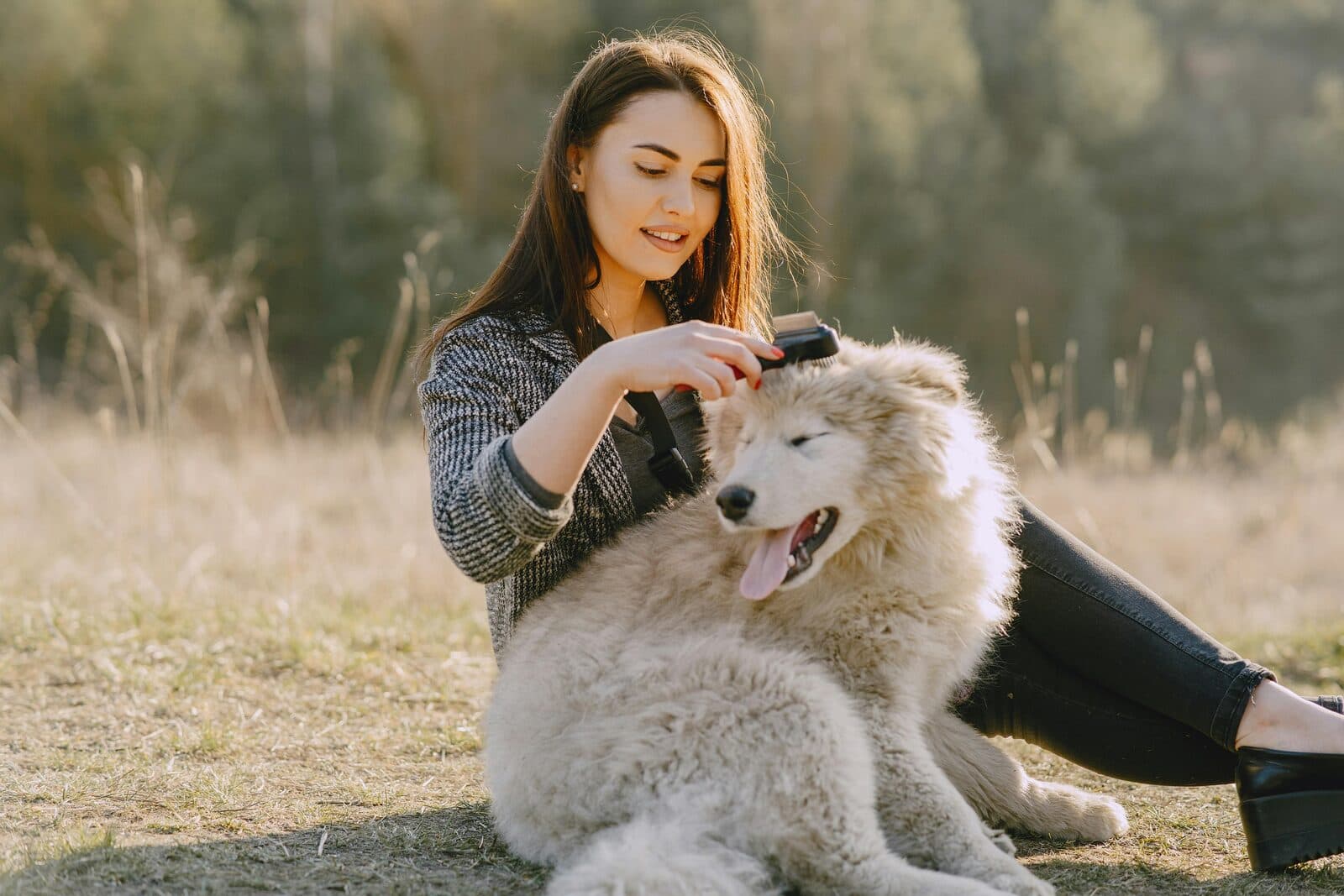
To brush your dog at home properly, you need three things: the right brush for the coat type, the right technique (line combing with a 45-degree slicker angle), and the right timing (always before the bath, not after). Most owners in Lisbon use the wrong tool, brush only the surface of the coat, and then wonder why their Portuguese Water Dog comes into our salon with matts against the skin. This guide fixes that.
Know Your Dog's Coat First
Everything in this guide depends on knowing which of the five coat types your dog has. Before buying a single tool, figure this out honestly. Mixed breeds often sit between categories, and in that case the more demanding parent wins.
Smooth coat. Short, dense, close to the skin. Breeds: Labrador, Beagle, Boxer, Dalmatian. People assume these dogs don't need brushing. They do, just not with a slicker. Loose hair builds up and skin oils redistribute better when you brush.
Double coat. Two layers, a soft insulating undercoat and a coarser guard coat on top. Breeds: Golden Retriever, German Shepherd, Husky, Pomeranian, Corgi. In Lisbon's spring and autumn, these dogs blow their coat, and if you don't rake it out, it mats against the skin and traps heat and moisture.
Wire or harsh coat. Coarse, bristly, sits up off the body. Breeds: Jack Russell Terrier, Wire Fox Terrier, Schnauzer, Airedale. This is hand-stripping territory. Brushing helps maintenance, but it doesn't replace the stripping process.
Curly or wavy coat. Coils or waves that don't shed much but tangle easily. Breeds: Poodle, Bichon Frise, Portuguese Water Dog, all Doodles (F1, F1B, Goldendoodle, Labradoodle, Cockapoo). This is the highest-maintenance category. The coat keeps growing like human hair, and matts form at the skin before you see them on the surface.
Silky or long coat. Fine, flowing, often parted down the back. Breeds: Yorkshire Terrier, Shih Tzu, Maltese, Cocker Spaniel (furnished). Tangles constantly, especially where the harness or collar sits.
If you're not sure which one you have, look at the coat at skin level, not at the tips. A Cocker puppy looks smooth until the adult furnishings come in at 8-12 months and suddenly you have a silky-coated dog.

Viktoria's Tool Kit (And What We'd Never Recommend)
In our salon we own maybe thirty different brushes. You don't need thirty. You need four or five, chosen for your coat type. Here's what actually works.
Slicker brush. The universal tool for curly, silky and double coats. Bent fine wires on a flat or slightly cushioned pad. Chris Christensen Big G and Artero are brands pro groomers in Europe use and trust. The technique matters more than the brand: you hold it at roughly 45 degrees to the coat and lift, you don't drag it flat and hard. Dragged flat, a slicker burns the skin raw in seconds, especially on pink-skinned breeds.
Metal comb, sometimes called a greyhound comb. This is your quality-control tool. Nothing else tells you honestly whether the section is clean. Medium-to-wide tooth spacing on one end, fine on the other. Andis and Artero both make solid options. If the comb doesn't glide from the skin out to the tip, the section isn't done.
Undercoat rake. Only for double-coated breeds, and mostly during the two shedding seasons. Long, rounded pins or blade-style rakes that reach through the guard coat into the undercoat. Use gentle strokes, follow the direction of hair growth. This pulls out the dead undercoat without cutting the guard hairs.
Pin brush. Long straight pins with rounded tips on a cushioned pad. Low duty. Good for silky coats between more thorough sessions and for distributing oil on a show coat. Useless on a Doodle or a Portuguese Water Dog, because the pins just glide over matts instead of catching them. Owners who ask us why their Doodle is matted 'even though we brush every day' are almost always using a pin brush.
Bristle or rubber brush. For smooth coats. A rubber curry brush (Kong Zoom Groom, Furbliss) lifts loose hair and feels like a massage. Bristle brushes redistribute skin oil and add shine.
Stripping knife or coarse stripping stone. For wire coats. This is how you maintain the harsh texture that brushing alone will soften and ruin. Full explanation lives in our hand-stripping post, but briefly: you pluck the dead coat, you don't cut it. Cutting destroys the wire texture and, over time, the colour.
What we'd never recommend. Two tools to avoid:
Furminator-style deshedding blades on double coats. The sharp edge cuts guard hairs, thinning and damaging the topcoat over time. Many professional groomers stopped using this tool entirely on double-coated breeds for exactly this reason. A proper undercoat rake does the same shedding job without cutting the guard coat.
Plastic 'dematter' blades with hooked teeth. These are sold everywhere as a shortcut, and they cut through the coat instead of working the knot out. On a Doodle or PWD you'll see the result two weeks later, a coat full of uneven chopped ends that can't hold a clean style.
How to Brush Your Dog Step by Step
This is the routine we teach every new owner who comes into the salon asking for help. It works on any coat. Adjust the tools based on the coat type, but the sequence stays the same.
1. Pick the brush that matches the coat. Smooth coat: rubber curry or bristle brush. Double coat: undercoat rake plus slicker. Wire coat: slicker for maintenance, stripping knife every 6-8 weeks. Curly or silky coat: slicker plus metal comb. Having the wrong tool in hand is the single most common reason home brushing fails.
2. Set the scene. Short session to start, ten to fifteen minutes. Treats ready, a few cubes of cheese or chicken. Non-slip surface, bathroom floor with a towel or a grooming table if you have one. Dogs who hate being groomed are almost always dogs who were forced through a two-hour session as puppies. Build the positive association first.
3. Start with the smooth areas. Back, shoulders, sides. This is warm-up, not where matts live. Let the dog relax into the rhythm, reward calm behaviour with a treat, breathe. If you start with the legs or belly, the sensitive zones, the dog tenses and the session goes downhill fast.
4. Work in small sections from the skin outward. This is the heart of it. Lift the top layer of coat with one hand, brush the section underneath from the skin out. Move two centimetres, do the next section. Thin sections, slow hands. Nobody matts on the surface, they matt at the skin.
5. Slicker first, then comb to verify. Run the slicker at 45 degrees with a gentle lift, not a drag. Follow with the metal comb, fine end, through the same section from skin to tip. If the comb catches, go back to the slicker, work that spot, comb again. Repeat until the comb glides.
6. Hit the tough spots last. Behind the ears, armpits, chest between the front legs, tail base, trousers (the back of the hind legs), under the collar or harness. These are where every serious matt starts. Do them last, when the dog is relaxed and used to the rhythm, and with extra patience.
7. Check by metal comb. This is the test that separates surface brushing from real grooming. The metal comb should move from skin to tip without catching, without dragging, without pulling. If it doesn't, the section needs more work. A slicker alone lies to you, the comb tells the truth.
8. End with reward before the dog gets overwhelmed. Stop on a good note, always. Ten minutes done well is better than thirty minutes ending in tears. Treat, praise, walk away. Tomorrow you do another section. A dog that enjoys brushing is a dog that stays mat-free for life.
Line Combing: How Groomers Check Your Work
Line combing is the difference between brushing a dog and actually grooming one. Every pro groomer uses it, and almost no owners do. It takes five minutes longer and it catches 90 percent of the matts that otherwise become a problem at the next bath.
The technique: part the coat horizontally, like sectioning hair before cutting. Use one hand to hold the top portion up and out of the way, leaving a clean parting at the skin. Brush that revealed section with the slicker, from the skin out to the tips, at 45 degrees. Then check with the metal comb, fine end, skin to tip, same line.
Move the parting up by two centimetres and do the next line. Keep going from belly up to spine, then do the other side. On a Doodle or Portuguese Water Dog, a full line comb takes 30-45 minutes if you haven't done it recently, and 10-15 minutes if you do it weekly. The weekly rhythm is the whole point.
Why top-down brushing doesn't work. A slicker dragged across the surface of a Doodle coat feels productive, and the tips look beautifully fluffy. Underneath, at the skin, the coat is compacting into felt. You can't see it until the matts reach the surface, and by then the dog needs a shave-down. We see this almost daily in the salon, especially in the first Atlantic-humid months after a family gets their first doodle.
Line combing is boring. It's repetitive and slow. It is also the only way to keep a dog with a demanding coat truly mat-free between grooms.

Common Mistakes That Make It Worse
We see the same mistakes almost every week, usually from owners who were genuinely trying to do the right thing. Here are the ones worth correcting immediately.
- Brushing a wet dog. Water tightens the matt, the fibres bind together, and what would have taken three minutes dry now takes forty-five and hurts. Always brush fully dry, always before the bath.
- Dragging the slicker through matts. If the brush catches, the instinct is to pull harder. Don't. The pins grind into the skin, the dog flinches, the matt stays. Break the matt into smaller pieces with your fingers first, then work each piece with the slicker tip.
- Wrong tool for the coat. A pin brush on a Doodle is the classic. The pins are too long and too smooth, they glide over the matt instead of catching it. A slicker on a Labrador is the other extreme, mostly pointless. Match the tool to the coat, every time.
- Skipping the high-mat zones. Armpits, behind the ears, under the collar or harness, tail base. Owners brush the back because the back is easy. The matts form where the coat moves against itself all day. Start thinking of those zones as the real job.
- Only brushing the top coat, not reaching the skin. This is the single biggest mistake on curly and double coats. The slicker never touches the skin, so the surface looks fluffy while felt builds underneath. Line combing fixes this. Nothing else does.
- Too much pressure. Slicker burn is a real thing. Red, irritated, weeping skin that looks like a rash. It comes from pressing the brush hard and dragging it flat. Hold the slicker like a pencil, barely touching the skin, let the pins do the work.
- Bathing without brushing out matts first. This is how a small matt becomes a full felt patch. Water and shampoo tighten every loose knot into a locked one. Dry brush first, always, until the metal comb glides through, then bath.
When Home Brushing Isn't Enough
There is a point where home brushing stops being effective, and pretending otherwise only hurts the dog. Know the signs:
- Matts feel tight against the skin and you can't get a comb under them.
- You see felted patches, flat plates of coat that move as one piece.
- The skin underneath looks red, raw, flaky, or smells slightly yeasty.
- The dog, previously tolerant, now flinches, snaps or hides when the brush comes out.
Any one of these means it's time to book a professional. We will assess the skin, decide honestly whether the coat can be saved or needs to come down short, and show you exactly where your routine is missing a zone. A Full Body Grooming at PawsN'Surf starts from 45 euros and includes the coat work, skin check, ears, and nails.
If you want to read more before coming in, our guide to preventing matts goes deeper on dematting decisions, and the coat-care-between-grooming post covers the weekly routine that prevents this situation entirely.